Silly Shepherds · About a 10-minute read
Once you decide you want a German Shepherd, it takes about one Google search to encounter the question that divides the community.
Working line or show line?
And then it begins.
Forums full of opinions. Breeders defending their own lines. YouTube videos of impressive dogs doing things you will never ask your future dog to do.
Somewhere in the middle, there you are, wondering: Which one should I choose?
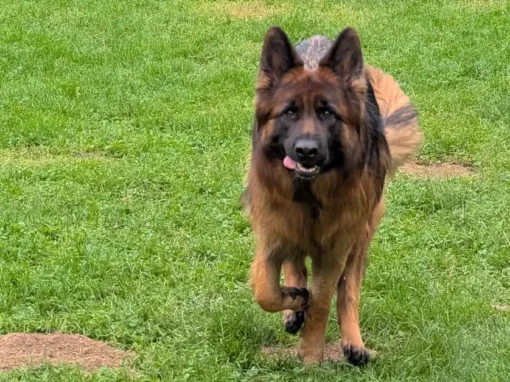
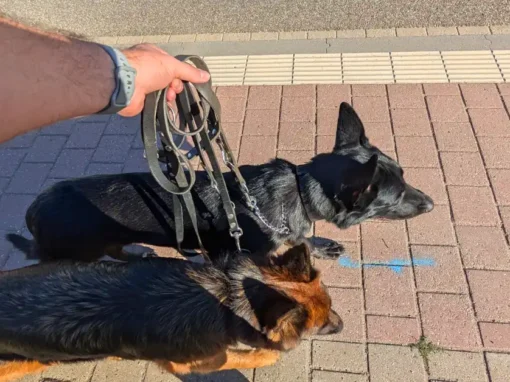
We’ve spent nearly thirty years living with this breed. From Schadow, the shelter girl nobody wanted, to Zara—our long-haired whirlwind, born to two standard-coated parents.
Surprising to see, but genetically quite possible when both parents carry the recessive long-coat variant.
This is our honest look at the working line vs show line German Shepherd debate.
No pretending there is one right answer for everyone. Just the differences, the questions worth asking, and our own experience.
How Did the Different Lines Develop?
We touched on this in our article about German Shepherd history. But the background deserves a closer look.
Max von Stephanitz, who helped establish the breed in 1899, placed working ability at the center of his breeding goals.
Appearance, temperament, and physical soundness were meant to support a dog that could work.
As the breed became internationally popular, breeders pursued different priorities.
Over generations, some placed greater emphasis on working performance. Others focused more on conformation: how a dog’s appearance and movement were assessed against the breed standard.
The distinction developed gradually. It was not one sudden split, and there are more than two uniform groups.
Today, “working line” and “show line” are useful descriptions of breeding priorities.
They are not complete descriptions of an individual dog.
What Is a Show-Line German Shepherd?
Show-line breeding generally places greater emphasis on appearance, movement, and assessment in the conformation ring.
Many European show-line dogs are black and red, often with more pronounced rear angulation. Other countries and breeding families have their own styles.
Compared with dogs bred specifically for demanding work, some show-line dogs may have been selected less intensively for working drive.
But differences between breeders and individual dogs are substantial.
A well-bred show-line Shepherd in a suitable home can be an excellent companion: loyal, intelligent, affectionate, and capable of much more than looking impressive.
Show-line dogs can also train, compete, and earn working titles.
There is, however, a concern that deserves discussion.
When Appearance Becomes Exaggerated
Excessive rear angulation or unstable hindquarters can compromise efficient movement.
At the same time, a sloping outline in a photograph does not automatically mean a dog is unhealthy.
Structure, stance, muscle development, and the way the dog is positioned all affect what you see.
Look beyond the stacked show photograph. Watch the dog standing naturally and moving freely.
Does that mean show-line dogs are generally less healthy?
That conclusion is too broad.
Responsible breeders in both show and working lines screen their dogs and consider health, temperament, and function.
Still, exaggerated structure deserves scrutiny. Loving a breed does not mean overlooking choices that may compromise its welfare.
What Is a Working-Line German Shepherd?
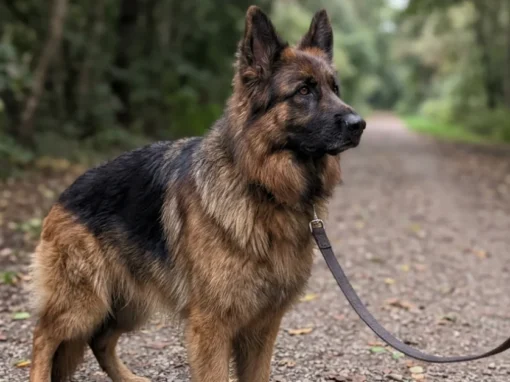
Put a working-line Shepherd beside a show-line Shepherd and you may notice differences.
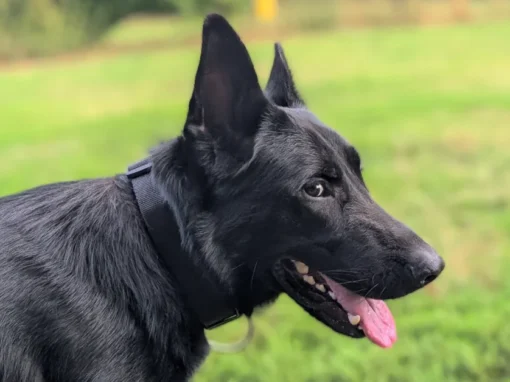
Many working-line dogs have less exaggerated rear angulation. Sable and black are common colors, although color alone does not identify a dog’s line.
The important differences go beyond appearance.
Working-line breeders generally place stronger emphasis on qualities such as:
- Motivation to work.
- Trainability.
- Persistence.
- Physical stamina.
- Confidence and recovery after stress.
- Abilities relevant to the intended work.
The balance of those qualities varies between breeding families, pairings, and individual dogs.
These are the dogs often associated with police work, detection, search and rescue, and working-dog sports.
That can be impressive.
It can also be a great deal to live with.
A highly driven dog without suitable outlets can feel like a race car stuck in traffic: plenty of capability, very little opportunity to use it.
A working-line Shepherd needs an owner prepared to invest time consistently.
Training. Mental engagement. Appropriate physical activity. And learning to settle, too.
That does not mean every working-line dog needs a professional job. Scent work, tracking, suitable sports, and thoughtfully planned everyday activities can provide worthwhile outlets.
But it does mean you should understand the needs of the particular dog you are considering.
If those needs fit your life, the partnership can be extraordinary.
If they do not, the challenge should not be underestimated.
Health: An Honest Comparison
You will often hear that working lines are automatically healthier than show lines.
It is not that simple.
Hip and elbow dysplasia occur in both. Inherited risk does not stop at the boundary between breeding labels.
Screening, family history, genetic diversity, structure, temperament, and breeding goals all matter.
A straight-looking back is not a health certificate.
Neither is a pedigree.
Ask for Official Results
Ask for the official hip and elbow screening results for both parents.
Have the breeder explain which system was used and what the results mean.
Screening schemes differ internationally. For example, US OFA classifications, UK BVA/KC scores, and German SV classifications are not interchangeable.
Where possible, check results through the relevant official database or registry.
Ask about other appropriate health tests, including DNA tests where relevant.
A DNA panel is useful information, but it does not replace physical screening or guarantee a healthy puppy.
Look Beyond the Certificates
A careful breeder considers more than passing test results.
Ask about:
- Health and longevity in related dogs.
- Temperament in everyday life.
- How the parents cope with stress.
- The strengths and weaknesses of the planned pairing.
- Why the breeder chose those two dogs.
Read the written purchase agreement. Understand the arrangements for support, transfer of ownership, and what happens if a hereditary or congenital condition is discovered.
The useful question is not only “Show or work?”
It is also “Which breeder, which parents, and why this pairing?”
What About Mixed Working and Show Ancestry?
Some breeders combine dogs from working-oriented and show-oriented families.
You may hear these described informally as combined lines or mixed working/show lines.
Such pairings can produce interesting dogs.
They do not automatically deliver the best of both worlds.
Traits do not blend into a predictable average. Puppies in the same litter can differ, and the breeder needs a thorough understanding of the parents and their relatives.
Coat length is a separate issue.
A long-haired puppy born to standard-coated parents is not, by itself, evidence of mixed working and show ancestry.
Which brings us to Zara.
Zara: Our Long-Haired Surprise
We were looking for a long-haired German Shepherd with a pedigree and parents whose health screening we could check.
We found her through J. Krabbe-IJzerman in Zwartsluis, in the northern Netherlands.
The breeder worked within the Dutch German Shepherd breed-club system and used a formal purchase agreement.
Zara’s registered name is Perle v.d. Zomerdijkslanden.
Her father is Grimm della Valcuvia, registration number SZ 2381311, who holds an IGP3 title.
Her mother is Viby v.d. Zomerdijkslanden. The breeding information supplied to us listed normal hip and elbow results and an IGP1 title.
Both parents had standard coats.