
Silly Shepherds · About a 10-minute read
School is back in session. And every year, parents who have a German Shepherd—or are thinking about getting one—ask the same question:
Are German Shepherds good with kids?
The honest answer has more layers than most websites suggest. Some give you an enthusiastic yes. Others point to bite statistics and leave it at that.
We want to give you a fuller picture. Nearly 30 years with this breed. Eight children in our family, from newborns to teenagers. And experiences ranging from Schadow, who heard every little sound our babies made, to Odin, who is still learning his way around family life.
What Bite Statistics Tell Us—and Why Context Matters
Let’s start with the part nobody particularly enjoys discussing.
German Shepherds appear in some studies of dog bite incidents. But interpreting those figures takes care. How common was each breed in the population? How reliably was the dog’s breed identified? What happened before the bite?
Those details matter. Breed alone cannot tell you whether an individual dog will bite. A large, powerful dog can, however, cause serious injuries if something goes wrong.
Everyday interactions can become risky when a child gets too close and a dog’s discomfort goes unnoticed. Children may struggle to recognize subtle signals. That leaves adults responsible for managing distance, guiding interactions, and paying attention.
Understanding dog body language helps at any size and with any breed. With a German Shepherd, there is also the strength of the dog to consider.
Living with German Shepherds and kids takes knowledge, training, and active supervision. Even when the relationship seems wonderful.
Why German Shepherds Can Be Wonderful Family Dogs
This is also a breed known for demanding work: police work, search and rescue, and assistance roles.
German Shepherds are intelligent and highly trainable. Those qualities can help in family life, but they do not replace socialization, guidance, or supervision.
Many become deeply attached to their families and build close relationships with children. That does not mean they automatically understand how vulnerable a child is.
Even an affectionate family dog can be startled, in pain, guarding something, or overwhelmed.
We experienced a remarkable bond with Schadow. We also learned that a bond is something you care for—not a promise that nothing can go wrong.
Schadow—the Dog Who Heard Everything
Four of our children were born at home: Isis, Benoe, Runar, and Jeran. Schadow was nearby for every birth.
She wasn’t in the room itself, but she heard everything. The sounds of labor. People going up and down the stairs. The cries. The quiet afterward.
She took it all in.
After Isis was born, we chose a calm, supervised introduction.
Schadow sniffed gently, briefly licked her little face, and then licked my hand. At the time, we took that as acceptance. Today, we would handle that first meeting more cautiously and prevent face licking.
One peaceful introduction also tells you very little about all the interactions still to come. A relationship between a dog and a child needs ongoing guidance.
Schadow became wonderfully attentive to the children. At the slightest sound, she would wake up and head toward the door. That is why we remember her as our four-legged baby monitor—an affectionate description, never a substitute for adult care or proper monitoring.
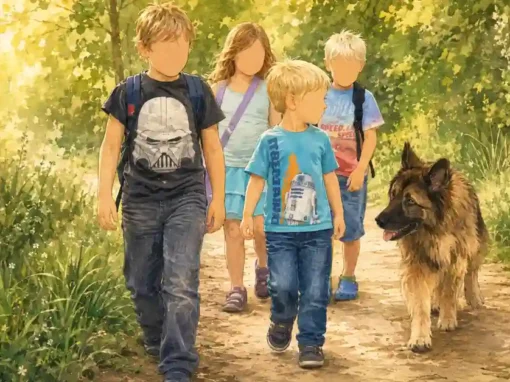
When the children played outside, she watched them closely. If they wandered too far apart, she sometimes nudged them back together with her nose. Gently, but with purpose.
In the woods, search games with Benoe and Runar were her favorite. She would go ahead, look back, and wait.
Nobody got left behind.
Those are the moments you remember for the rest of your life.
How Do You Introduce Your German Shepherd to a Newborn?
A first introduction is an important beginning. The relationship keeps developing afterward, especially as a baby starts crawling, walking, and reaching for things.
Before the Birth: Prepare Gradually
Start well before the baby arrives.
Introduce baby equipment, gates, and changes in routine gradually. Play recordings of baby sounds quietly, rewarding relaxed behavior. If your dog seems worried, lower the volume or stop.
Help your dog learn to settle comfortably in a quiet place or behind a gate before you need that arrangement.
You can also let your dog investigate a blanket or clothing item carrying your own baby’s scent before the baby comes home. Supervise this and keep it from becoming a chew toy.
Decide ahead of time which rooms your dog will have access to. If the nursery will be off-limits, introduce that boundary early. Your dog can remain part of family life while having clear limits.
The First Meeting: Calm, Brief, and With Space
For the first introduction, have one adult hold the baby securely while another manages the dog.
Begin at a comfortable distance. Reward calm behavior. There is no need for your dog to approach immediately, and no reason to bring his nose close to the baby’s face.
A loose leash may help, depending on the dog. If he becomes excited, tense, or uncertain, increase the distance or use a gate.
If everyone is comfortable and the dog remains relaxed, a brief sniff near the baby’s feet or a separate blanket may be appropriate. Direct contact is optional.
Keep the meeting short. Stop at the first sign of discomfort.
Give your dog time to adjust without forcing interaction. The adults remain responsible for distance and safety throughout.
After the Birth: Keep Life Predictable
A new baby changes the household. Less sleep, more visitors, different walks, and less uninterrupted attention can all affect your dog.
Prepare for likely changes in advance. Afterward, maintain a manageable routine with regular meals, suitable exercise, quiet rest, and individual attention.
Perfect consistency is unlikely with a newborn. Familiar routines can still help your dog settle into the changes.
What Children Need to Learn About Dog Body Language
This is easy to overlook. It deserves a place alongside every other household rule.
Teaching children to recognize discomfort can help them interact more thoughtfully. Keeping everyone safe remains the adult’s responsibility.
One signal does not always tell the whole story. A dog may yawn because he is tired or lick his lips after eating.
Look at the situation and combinations of signals, including:
- Looking away or turning his head.
- Licking his lips or repeatedly yawning.
- Holding his ears back.
- Trying to move away.
- Becoming still or stiff.
- Staring intensely.
- Growling.
Freezing, a hard stare, and growling deserve an immediate response: calmly create distance.
Do not punish a growl. It communicates discomfort; suppressing the warning does not resolve the cause.
Teach children to stop interacting, move away calmly rather than run, and tell an adult. Adults should step in early, before a child has to work out what to do.
If growling recurs, seek help from a veterinarian and a qualified dog behavior professional.
The Rules That Matter Every Day
After nearly 30 years of family life with German Shepherds, these are the rules we want every household to take seriously.
Never Leave Young Children Alone With a Dog
However affectionate the dog is. However close the relationship seems.
Not for five minutes. Not while you quickly do something else.
Active supervision means an adult is awake, close enough to intervene, and actually watching the interaction.
If you cannot do that, separate the dog and child with a secure gate, door, or suitable separate space.
Being in the same room while distracted is not active supervision. That includes interactions with your own familiar family dog.
Give Your Dog a Child-Free Place to Rest
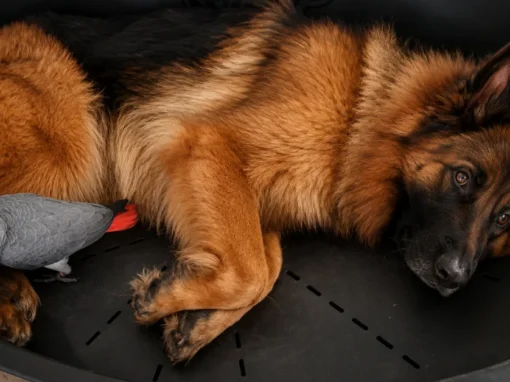
A bed, a quiet corner, or a crate the dog already finds comfortable can provide a place to unwind.
Children should not follow him there, reach into his crate, or block his way out.
Everyone needs a break. Your dog needs to be able to take one.
Give Him Space When He Is Busy or Uncomfortable
Keep children away when your dog is:
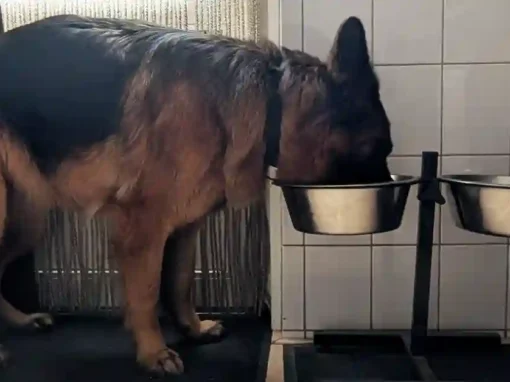
- Eating or near his food bowl.
- Sleeping or resting.
- Enjoying a chew, toy, or something he has found.
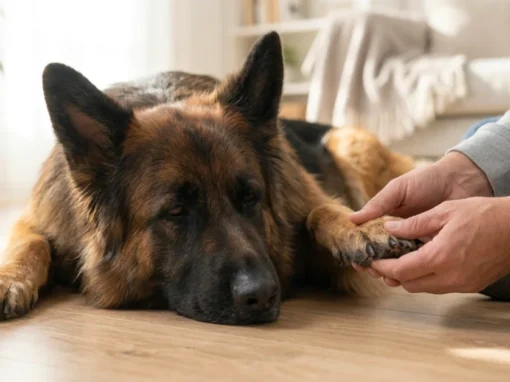
- Sick, injured, or tired.
- Retreating under furniture or into his bed.
- Highly excited.
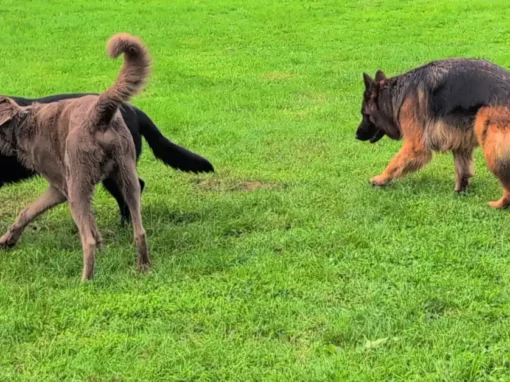
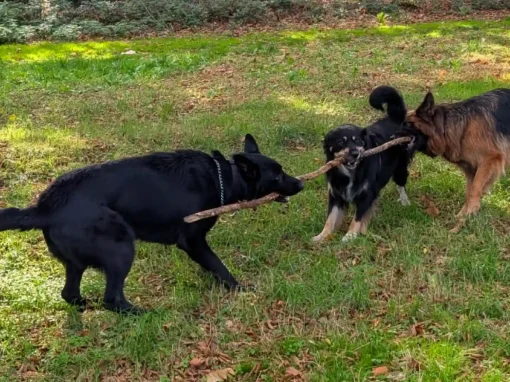
- Playing intensely with another dog or involved in tension between dogs.
Children should never step between dogs to break up an argument.
No Pulling, Climbing, or Forced Hugs
No pulling ears, tails, or fur. No climbing on the dog.
Small children are still learning that other living things can feel pain. Adults need to guide them gently and consistently.
Hugs and kisses can also make a dog feel trapped. Teach gentle petting, and let the dog move away when he wants to.
Your Dog Is a Living Member of the Family
He has his own needs, preferences, and limits.
Helping children understand those limits gives both sides a better chance of building a lasting bond.
Ayla, Zara, and Odin—Three Different Stories
Ayla was less focused on the children than Schadow had been.
Sticks, balls, swimming—that was her world.
But something changed around our first grandson, Julius. We noticed that she became quieter and more careful near him.
That was Ayla as we knew her. We still supervised their interactions.
Zara responds remarkably well to Stella: twelve years old, calm, and confident.
A calm, predictable child can be easier for a dog to understand than one who suddenly runs, screams, or follows him around. What matters here is how comfortable the interaction feels to the dog.
Odin is still a work in progress.
At the time of writing, he had been with us for three weeks. On day one, he rested his head in our daughter’s lap. Around some people in the house, he still growled.
We take that seriously.
Until we understand what is causing his discomfort, we do not allow unrestricted contact with children or visitors. We use distance and physical separation, and we do not force introductions.
Repeated growling calls for a veterinary assessment to check for pain or illness, alongside help from a qualified behavior professional.
Living with German Shepherds and kids keeps evolving. A dog’s breed, affection, or history of good interactions cannot replace attentive adults, sensible boundaries, and help when concerns arise.
More to read:
- German Shepherd Adolescence — When They Forget Everything You Taught Them
- Feeding Your German Shepherd — Kibble, BARF, or Fresh?
- Odin Week 3 — Three Weeks In, and Things Are Starting to Click
German Shepherds and Kids: What to Remember
- German Shepherds can form extraordinary bonds with children. Every dog still needs individual consideration.
- Breed alone does not predict whether a dog will bite.
- Introduce a newborn gradually, with enough space and adults managing the interaction.
- Help children recognize discomfort, while keeping responsibility with the adults.
- Never leave young children alone with a dog.
- Separate them safely whenever you cannot actively supervise.
- Give your dog a quiet, child-free resting place.
- Take repeated growling seriously and seek veterinary and behavioral help.
Are your children growing up with a German Shepherd? Or are you preparing to introduce your dog to a new baby?
Share your experience or questions in the comments.
Follow us on YouTube, TikTok, and Instagram for more from everyday life with Zara and Odin.
🐕 Experience, With the Facts in Mind
Nearly 30 years with German Shepherds. Eight children. Plenty of memories and lessons along the way. These are our family’s experiences, supported by practical safety guidance. Every dog, every child, and every household is different.