Silly Shepherds · about a 10-minute read
You’re enjoying a quiet walk with your Shepherd. Everything is going well. Then, suddenly, a hundred yards away: another dog.
And your Shepherd is gone. Not physically, but mentally. He no longer seems to hear you. All he can see is that one thing at the end of the leash.
That kind of intense response is often described as reactivity. If you live with a German Shepherd, it may look familiar. This breed is alert, watchful, and quick to notice what’s happening around him — qualities that helped make him a capable working dog. In some individuals, that sensitivity can also make everyday situations harder to handle.
In this article, we explain what German Shepherd reactivity means, why it develops, how to recognize it, and, above all, what can help.
What exactly is reactivity?
Reactivity is an unusually strong, often intense response to a trigger: another dog, a cyclist, a sound, or an unfamiliar person. The dog may bark, pull, lunge, growl, or freeze.
Reactivity describes the intensity of the response, rather than its cause. Fear, uncertainty, frustration, and excitement can all play a part.
Some dogs want to keep the trigger away or make it leave. Others want to approach it and become frustrated because the leash or the situation prevents them.
Barking and lunging alone don’t always tell you which motivation is involved. The behavior can also involve aggression and lead to biting. That’s why it needs attention, and why punishment generally isn’t the answer: it doesn’t address the underlying emotion and can make the situation worse.
Reactivity isn’t the same as having lots of energy or getting excited easily. A dog can be energetic and easily distracted without being reactive. Reactivity specifically concerns an intense response to a particular trigger that the dog struggles to regulate.
Why can German Shepherds be sensitive to triggers?
This breed was developed to stay alert, notice changes in the environment, and respond to them. Those qualities can be valuable in a working dog.
We can’t confidently claim that German Shepherds are more reactive than other breeds. But in some individual dogs, the alertness associated with the breed may go hand in hand with greater sensitivity to their surroundings.
There are big differences within the breed. One Shepherd takes almost everything in stride. Another notices every little change.
Other factors may contribute too: limited or poorly managed early socialization, frightening experiences with dogs or people, inherited tendencies toward fearfulness or alertness, or a daily routine with too much stimulation and too little rest.
An adult dog joining a new family may also bring reactions shaped by experiences nobody knows about. Those reactions don’t necessarily originate in the current home.
Reactivity rarely has one simple cause. It usually involves a combination of individual predisposition and experience.
Trigger stacking: why one day can be different from the next
An important concept in reactivity is trigger stacking: smaller stressful experiences building up until the dog struggles to cope.
A dog who was startled by the vacuum cleaner in the morning, encountered two cyclists on a walk, and then spent time in a veterinary waiting room may have less capacity left for the dog he meets on the corner that afternoon.
Not because that last dog is more threatening, but because the earlier experiences have added up.
Stress doesn’t necessarily disappear the moment a trigger goes away. Your dog needs time to recover.
That can help explain why he ignores something one day and reacts strongly to the same thing the next. It may reflect his overall stress level that day, rather than anything inconsistent you’ve done.
The threshold: when calm practice becomes difficult
A dog’s threshold is the point at which a trigger becomes too close or too intense for him to handle comfortably. It can change with the situation and his stress level.
Below threshold, your dog notices the trigger but can still respond to you. He may take treats, respond to his name, and look away on his own. This is where calm practice is usually most productive.
Over threshold, he may stare, stiffen, bark, or pull, and struggle to respond to food or familiar cues.
Taking food isn’t a reliable test by itself. Look at his posture, how intensely he’s watching, and whether he can disengage.
Learning doesn’t stop when a dog becomes overwhelmed. But calm practice becomes harder, and he may learn associations you don’t want — such as another dog predicting an unpleasant experience.
Increase the distance and give him room to recover rather than pushing through.
A central principle in addressing reactivity is therefore: practice below threshold and create more distance when your dog starts struggling.
Moving closer to “get him used to it” can be too much. More distance gives him a better chance to stay comfortable.
Recognizing body language before a reaction
A reactive episode can feel as though it came out of nowhere. Often, though, there were earlier signs.
Possible signs of rising tension include ears held forward or pinned back, a stiffer posture, raised hair along the back, a higher or more rigid tail, panting when it isn’t hot, and a fixed stare at the trigger.
No single sign tells the whole story. Read the dog’s overall body language and the situation.
This is the moment to act: create distance, gently redirect his attention, or walk away.
Once he is already barking or lunging, you’ve missed the opportunity to prevent that particular outburst. You can still help him get out of the situation and recover.
What helps: counterconditioning and desensitization
Two established approaches used for reactivity are counterconditioning and desensitization, often combined.
Desensitization means introducing the trigger gradually, at an intensity your dog can comfortably handle.
You start far enough away that he notices it without becoming distressed. Only make the situation harder when he has repeatedly remained comfortable at the current level. Moving closer is one way to increase difficulty, but movement, duration, and the setting matter too.
Counterconditioning means changing what the trigger predicts for your dog.
When the trigger appears, something good follows immediately — usually a particularly appealing treat. You aren’t asking him to perform a specific behavior first. You’re pairing the presence of the trigger with something he enjoys.
The association you’re building is:
The trigger appears → something good happens.
Over time, this can help change his emotional response.
Work at a manageable distance. If he becomes highly stressed or struggles to eat or engage, create more space and let him recover before continuing.
Management: not every situation needs to become a training session
Alongside training, management matters: arranging daily life so your dog is less often overwhelmed while you work on his reactions.
That might mean walking at quieter times, crossing the street when you spot a trigger ahead, choosing a calmer route, or replacing a demanding outing with a quieter day and suitable activities at home.
You’re giving your dog a chance to recover.
Many owners feel awkward stepping aside or turning around. There’s no need to.
Choosing not to practice in a situation that isn’t safe or manageable can prevent an incident and protect your dog’s progress.
What doesn’t help — and what can increase the risk
Punishing reactive behavior through harsh leash corrections, shouting, or physical intimidation doesn’t address its cause.
Your dog doesn’t necessarily learn that the trigger is harmless. He may instead learn that its appearance predicts something unpleasant from you. That can make the association worse.
Trying to “train through it” by keeping your dog closer to a trigger than he can handle can also backfire. Calm practice becomes harder, and repeated overwhelming exposure may increase his sensitivity.
A busy, unpredictable environment is a difficult place to practice simply because you happen to be there.
Choose your training opportunities deliberately, somewhere you can control the distance and leave when needed.
In practice: another dog suddenly comes around the corner
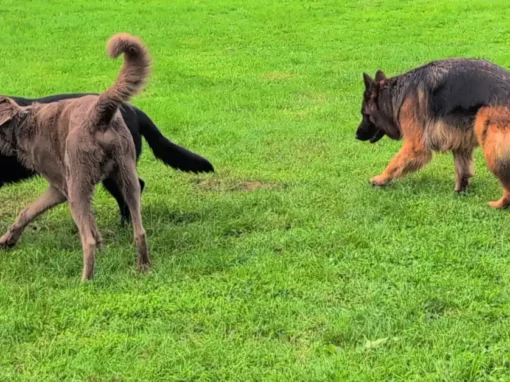
You can’t plan every encounter. Sometimes another dog appears just a few feet away before you have a chance to change direction.
Stay as calm as you can and focus on creating space.
Turn away, take a wider path, or cross the street if it’s safe. If moving away immediately isn’t possible, a parked car, hedge, or other visual barrier may help.
You can use your voice or a treat to encourage your dog to move with you, without jerking the leash. Avoid putting yourself between dogs who could bite; your own safety matters too.
The aim is to get through the encounter safely and reduce the pressure on your dog.
If he reacts despite your efforts, that doesn’t mean the training has failed. Once you’re safely away, give him time to settle and reconsider what he needs for the rest of the walk.
When should you get help?
With patience, an appropriate approach, and enough time, reactivity can often improve. But some situations need individual professional support.
Seek help if your dog bites or comes close to biting, if his reactions are escalating, if you feel unsafe on walks, or if you’re unsure how to recognize his threshold and work within it.
Choose a qualified trainer or behavior professional who uses rewards, gradual exposure, and management rather than corrections or dominance as the foundation of treatment.
If reactivity starts suddenly or becomes noticeably worse, arrange a veterinary assessment too. Pain or another medical problem may contribute to a change in behavior.
What to remember
A reactive dog isn’t a bad dog. Having a reactive dog doesn’t automatically mean you’ve done something wrong.
He’s a dog who currently finds certain situations difficult and needs help handling them.
Remember these main points: practice below threshold, recognize the early signs, use gradual exposure and positive associations, and make distance part of your plan.
Rest, clear routines, and predictability can help. Your role is to make situations more manageable and give your dog repeated opportunities to feel safe and succeed.
Does this sound familiar with your Shepherd? Share your experiences and ask questions in our Silly Shepherds Facebook group.
Follow us on YouTube, TikTok, and Instagram for weekly updates on Zara and Odin.
🐕 Experience, with the facts in mind
We write from nearly thirty years of living with German Shepherds, and we’re not behavior specialists. We describe personal experiences as personal experiences. We check behavioral information against reliable sources. And when something is uncertain, we say so.
Sources and further reading
- AAHA — Canine and Feline Behavior Management Guidelines
- Merck Veterinary Manual — Behavior Problems in Dogs
- Merck Veterinary Manual — General Guidelines for Effective Controlled Exposure Behavior Modification in Dogs