
Silly Shepherds · About an 11-minute read
People sometimes give us a strange look when we tell them which animals have shared our home.
German Shepherds. Cats. Ferrets. An African gray parrot. Small birds. A Bernese Mountain Dog. Guinea pigs in a secure, enclosed outdoor habitat in the yard.
And now Lio—our cat, whose name was inspired by Lilo & Stitch. Four weeks into life with Odin, she is already sitting beside him on the couch.
Nearly 30 years with German Shepherds. None of our dogs has ever seriously injured another pet in our household.
We think our approach has helped. But every dog and every combination of animals is different. Previous good experiences never guarantee safety.
That matters here, because some of the stories we’re about to share involved more risk than we appreciated at the time.
What Makes It Work—and Why It Isn’t Always Simple
Many German Shepherds respond strongly to movement. Some have a pronounced tendency to fixate on or chase other animals.
How strong that tendency is depends on the individual dog, including temperament, previous experiences, socialization, and training.
Predatory behavior is different from aggression driven by fear or conflict. A dog can learn to behave calmly around familiar pets while still having a strong urge to chase.
Fast, unexpected movement can trigger a response even after a long period of peaceful coexistence.
Socialization and training can help reduce risk. They do not automatically make a dog a safe companion for every other animal.
We’re seeing that distinction clearly with Odin.
Schadow—the Dog Who Shared Everything
Schadow was our first German Shepherd.
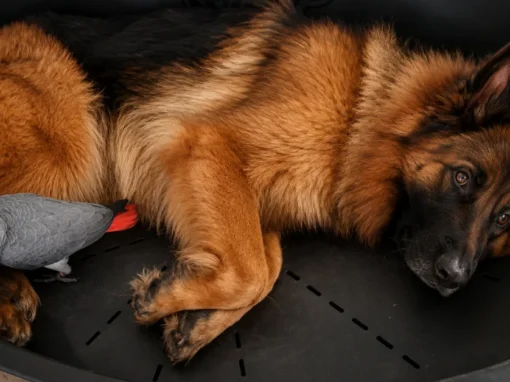
She shared her home with my former partner’s four cats, ferrets, and birds—including an African gray parrot.
The ferrets were perhaps the most surprising. Small, fast-moving animals with a distinctive scent can be a considerable challenge for a dog.
With Schadow, we had no incidents.
The African gray had a personality all his own. He regularly climbed into Schadow’s bed, and she allowed it.
Looking back, we recognize how easily that could have gone wrong. A dog can seriously injure a bird in an instant, even without intending to attack.
The fact that Schadow tolerated it does not make it something we recommend.
A calm owner can help keep an interaction calmer. But our mood cannot control every response a dog might have.
Calm, predictable handling often helped us. We still need to assess each situation on its own—including the stories we tell about our earlier dogs.
Ayla—the Queen With Company
Ayla had a different personality from Schadow.
More interested in doing her own thing. Less interested in cuddles.
She still shared her life with other animals.
Fey, our stepdaughter’s Bernese Mountain Dog, grew up with us. Two large dogs. One home.
It took clear routines and careful management, but it worked well.
Then came Zara.
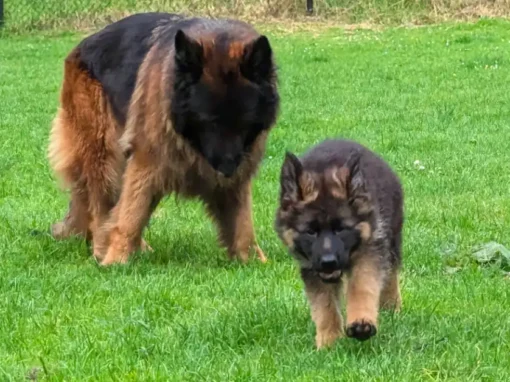
Ayla was already older when Zara arrived as a puppy. An older dog and a lively youngster made for an introduction we had to manage carefully.
With guidance, they found their way.
Zara and the Parrotlet—a Story That Could Have Ended Differently
We share this as a warning.
Zara once snapped at a small Forpus parrotlet and immediately let go.
The bird had no visible injuries, but the outcome could have been serious. We cannot say with certainty whether Zara’s response was exploratory, playful, or predatory.
What it taught us was clear: a large dog and a small bird should not have unprotected direct contact.
If a dog bites or catches a bird in its mouth, contact an avian veterinarian promptly—even if the bird looks uninjured. Injuries may be hidden beneath the feathers.
What happened afterward was unusual. The bird would sit on Zara’s back and regularly approach her.
That did not prove the interaction was safe. It did not prove the bird understood the risk, either.
It tells us what that particular bird did at that particular time.
Our cat and Zara also know each other well now. But we would handle their first meeting differently today.
We brought Lio home in a cat carrier, and that was where they first saw each other.
A confined cat cannot choose to move away.
Lio hissed loudly. Zara startled and barked.
They now share the couch, but that relationship developed over time. The first encounter deserves no credit for it.
A better starting point for a new cat is a separate, secure room with food, water, a litter box, resting places, and hiding spots.
Begin with scent swapping. Later, let the dog and cat see each other from a distance through a secure barrier, while the cat remains free to retreat.
Odin and Lio—Four Weeks of Work
With Odin, the situation was different.
He was almost two years old and had never lived with a cat. We needed to approach that differently from introducing a puppy.
We started at a distance.
Odin looked through the window. Lio sat on the windowsill.
We kept the sessions short. If Odin fixated, stiffened, whined, or leaned strongly forward, we increased the distance.
We rewarded relaxed behavior, looking away, and checking in with us.
We looked beyond barking or raised hackles. We also watched for:
- Stiffening or stalking.
- Prolonged staring.
- Shifting his weight forward.
- A closed mouth combined with a tense posture.
- No longer responding to his name or a reward.
- Attempts to block or chase the cat.
After a little over two weeks, we were no longer seeing those signs during the sessions.
Next came brief, supervised meetings in the same room.
Odin stayed on a loose leash. Lio could choose her distance. She had several elevated places and routes back to safety.
We prevented Odin from following her or blocking her way out.
Day 25: Lio sat under the table and gently tapped his muzzle a few times with her paw, without using her claws.
That can be a request for space. We did not automatically treat it as friendly play.
Odin remained calm, and we kept watching.
Day 27: Odin took a piece of kibble from his bowl and placed it near Lio.
What he meant by that, we cannot know.
Afterward, we prevented them from gathering around his food bowl. Food can create tension even between animals who usually get along.
We now prefer to feed them separately.
Outside Is a Different Story
We want to be honest about this: what works indoors does not automatically carry over outdoors.
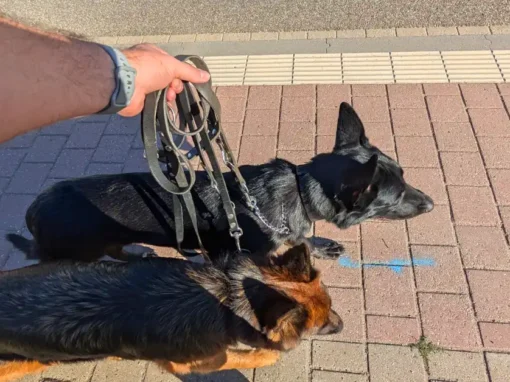
Odin notices cats under parked cars before I even see them.
Outside, there is more space, more movement, and more competing stimulation. Staying connected with me is harder for him.
Unfamiliar cats outdoors?
I would not trust him around them off-leash at this stage.
A dog can live peacefully with a familiar cat at home and still want to chase unfamiliar cats outside.
Those are different situations. Both require careful management.
How Do You Handle Introductions?
Nearly 30 years with different combinations of pets have taught us a great deal.
That includes recognizing what we would change about some of our earlier introductions.
Start With Scent
Before a dog and cat meet, let them become familiar with each other’s scent.
Exchange bedding or use separate cloths carrying each animal’s scent. Allow them to investigate without forcing them to approach.
For birds and small mammals, scent familiarity does not make direct contact safe.
Keep Distance Under Your Control
During early dog-and-cat meetings, keep the dog on a leash and allow the cat to retreat.
Do not hold the cat in place or force an approach.
Touching noses is not a goal you need to achieve.
Provide Genuine Escape Routes
Give the cat access to elevated resting places, a dog-free room, and more than one route to safety.
Avoid dead ends.
Prevent the dog from standing between the cat and her litter box, food, or safe room.
A cat who must stay on a shelf because the dog is waiting below may still feel trapped.
Reward Disengaging
Reward more than quiet staring.
Look for relaxed sniffing, turning away, responding to a name, checking in with you, and choosing to create distance.
If the dog becomes too focused to respond or take a reward, increase the distance. Do not wait for a lunge.
Build Gradually
Several short, manageable sessions are preferable to one prolonged encounter.
Finish while both animals are comfortable. If either becomes tense, end the interaction calmly and make the next session easier.
There is no fixed schedule.
Use Separation When You Cannot Supervise
Keep dogs and cats separate during the introduction period whenever you are not actively supervising.
A long history of calm behavior is useful information, but it is not proof that every future situation will be safe. If there is any doubt, continue separating them when you are away.
For birds and small mammals, maintain secure physical separation from the dog.
A cage alone may not be enough. A large dog can knock it over or injure an animal through the bars.
A separate, closed room provides an additional layer of protection.
Stay Calm—and Keep the Practical Safeguards
Your calm handling can help.
Distance, barriers, a leash, and attention to both animals’ behavior do the essential work.
Larger Animals Outdoors—Sheep, Horses, and Wildlife
This deserves its own section.
Odin regularly passes sheep and horses on our walks. That presents a different challenge from sharing a home with a cat.
On one early walk, we were too close, and I had to move him away.
After that, we began farther back, before he started staring intensely or pulling.
That gave us a better opportunity to practice calm behavior.
Around sheep and horses, we use a sturdy leash and suitable equipment, keep our distance, and prevent contact through fences.
If Odin starts fixating, barking, or pulling, we move away.
Approaching closer to “get him used to it” would add risk. A startled horse can injure itself, its rider, and a dog.
Wildlife needs space too.
Badgers, deer, and hares are not there for us to practice on.
Where wildlife is present, Odin stays on a leash or an appropriately managed long line. We prevent chasing and do not let him follow trails to dens or burrows.
He has certainly not forgotten the badger he encountered during his first few weeks. On evening walks, he still searches the bushes.
The urge to follow movement can remain strong. Better management and training do not mean we can assume it has disappeared.
More to read:
- Odin Week 4 — From a Loose Cannon to… the Cat’s New Friend
- The First Week With a German Shepherd Puppy — What Nobody Tells You
- German Shepherds and Kids — A Special Bond You Never Forget
German Shepherds and Other Pets: What to Remember
- Many German Shepherds respond strongly to movement. The intensity varies from dog to dog.
- Positive early experiences can help, but temperament, history, and predatory behavior also matter.
- Introductions should protect the more vulnerable animal throughout.
- Begin dog-and-cat introductions with scent familiarity and secure separation.
- Provide several safe retreat options, and prevent chasing or blocked exits.
- Reward relaxed behavior and the ability to turn attention away.
- Peaceful behavior indoors does not automatically transfer to unfamiliar animals outdoors.
- Keep birds and small mammals securely separated from dogs.
- If fixation or chasing persists, maintain separation and seek a qualified behavior professional.
- Some combinations of animals may never be suitable for direct contact.
Does your German Shepherd already live with a cat? Or are you thinking about adding another pet?
Share your experiences in the comments.
Follow us on YouTube, TikTok, and Instagram for more from everyday life with Zara, Odin, and Lio.
🐕 Experience, With the Facts in Mind
Ferrets, parrots, cats, guinea pigs, a Bernese Mountain Dog, and now Lio. Nearly 30 years of German Shepherds and other pets sharing our home. These are our personal experiences—including the moments we would handle differently today. And when something is uncertain, we say so.