
Feeding Your German Shepherd — Kibble, BARF, or Fresh Food: What Works for Your Dog?
Silly Shepherds · About an 11-minute read
Ask ten German Shepherd owners what they feed their dogs, and you will get ten different answers.
And ten different opinions about why the other nine are wrong.
Nutrition is one of the most debated subjects in the dog world. Raw feeders swear by raw meat. Kibble owners point to convenience and research. Fresh-food enthusiasts arrive with spreadsheets.
Everyone is convinced they have found the answer.
We have our preferences too.
But after nearly thirty years of living with German Shepherds — from Schadow to Zara — we have learned that no single feeding approach suits every dog.
There are, however, some useful lessons. And a few mistakes worth avoiding.
A quick clarification: in this article, we use “BARF” to describe homemade raw diets assembled from meat, bones, organs, and other ingredients. Commercial raw diets also exist.
By “fresh food,” we mean commercially prepared refrigerated or frozen meals, which may be cooked or raw. Neither “fresh” nor “commercially prepared” automatically means nutritionally complete.
Here is our honest experience with German Shepherd nutrition.
How We Started — Royal Canin Croc
Schadow, Troy, and Ayla all grew up eating Royal Canin Croc.
For years.
They did very well on it.
We remember its large, hard pieces, which encouraged our dogs to chew rather than simply gulp everything down. It was affordable too, which matters when you have a large dog with a healthy appetite.
That does not mean ordinary kibble automatically cleans teeth or improves digestion. Those benefits should not be assumed from the shape of the food.
Then the Croc we had been buying disappeared from our local market. The replacement available to us had smaller pieces and a much higher price.
We moved on.
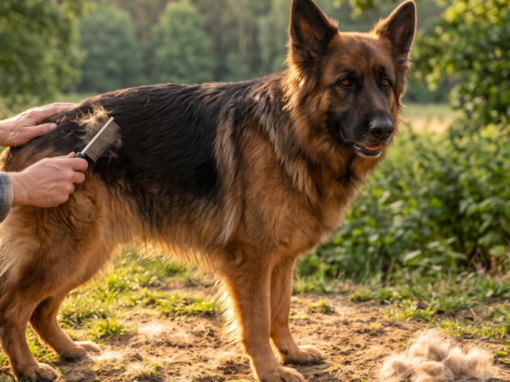
Cost was part of that decision. But when we changed foods for Zara, we also noticed that her coat seemed less glossy.
That observation did not prove the food was responsible. It did give us a reason to reassess what we were feeding her.
What Should You Look for in Dog Food?
The first ingredient does not tell the whole story.
Ingredients are generally listed by weight before processing. Fresh meat contains a lot of water, so it may appear higher on the list than a more concentrated ingredient such as meat meal.
The list alone tells you little about digestibility, nutritional balance, or manufacturing standards.
Start by checking whether the food is complete and balanced for your dog’s life stage and size.
Ask who formulates it, what nutritional expertise they have, and how the manufacturer checks quality. Feeding trials and published research can provide useful information too.
Label terminology varies by country. In the United States, look for the nutritional adequacy statement, often referring to AAFCO standards. In other markets, look for the relevant complete-food designation.
Do not assume that every bag, tray, or pouch is suitable as your dog’s entire diet.
Grains are not automatically “fillers,” either. They can contribute useful nutrients.
Judge the whole diet rather than choosing or rejecting it because of one ingredient.
Switching to Purina Pro Plan
We wanted an alternative suitable for a large adult dog, with skin and coat health in mind.
We settled on the salmon-based Purina Pro Plan Large Robust Adult Sensitive Skin formula sold in our market.
Product names and formulations may differ between countries. A similarly named product elsewhere is not necessarily identical, so check the local label.
For us, the important question is how Zara does on it.
We monitor her weight, body condition, energy, skin, and stool. We also check that the food is complete and appropriate for her age and size.
Those observations help us judge how well she tolerates it. They do not establish that this is the best food for every German Shepherd.
It is the food that currently works for her.
Moving From Puppy Food to Adult Food — Take Your Time
German Shepherd puppies need nutrition that supports large-breed growth.
Use a complete puppy diet specifically suitable for that purpose. Controlled energy intake and an appropriate calcium and phosphorus balance matter.
Do not add calcium or mineral supplements to a complete puppy diet unless your veterinarian recommends them.
The switch to adult food should follow your dog’s growth and the feeding guidance for the particular product. Large dogs can take longer to reach skeletal maturity, so check the timing with your veterinarian rather than relying on a birthday alone.
Zara switched at sixteen months.
That worked well for her.
How you change foods matters too. For a routine switch, this can be a useful starting point:
| Days | Previous food | New food |
|---|---|---|
| 1–2 | 75% | 25% |
| 3–4 | 50% | 50% |
| 5–6 | 25% | 75% |
| From day 7 | 0% | 100% |
A sensitive dog may need ten to fourteen days or longer.
This is a guide, not a rule for every situation. If your veterinarian recommends a different transition for a medical reason, follow that advice.
Watch your dog’s appetite and stool as you go.
The Egg Story — A Lesson We Share
This is a story we would rather not have to tell.
But we know other owners may make the same decision.
A few months ago, Zara sometimes left food in her bowl. She seemed less interested than usual.
We thought she might appreciate something extra.
A raw egg mixed in — surely that was healthy?
Raw egg white contains avidin, which can bind biotin, a B vitamin. An occasional whole raw egg is unlikely to cause an immediate deficiency, but raw eggs also carry a bacterial risk.
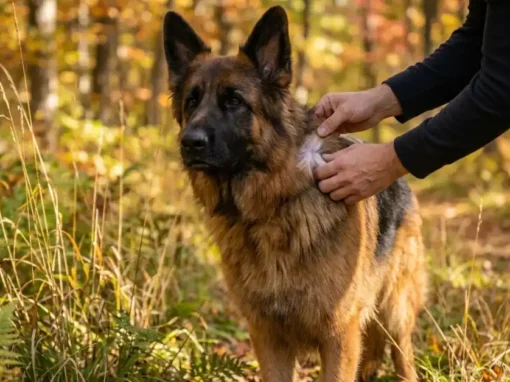
Not long afterward, Zara’s coat became dull and she started losing hair.
We never established that the egg caused it.
Shedding, parasites, allergies, or another issue could have been involved. The problems improved after we stopped giving it, but timing alone does not prove cause and effect.
If you occasionally offer egg, cook it thoroughly and serve it plain, without salt or seasonings.
Keep extras modest so they do not displace a balanced diet.
And if hair loss or skin problems keep coming back, have your veterinarian investigate the cause.
Your Dog May Not Empty the Bowl Every Time
New Shepherd owners can worry when their dog leaves food behind.
We saw it with Ayla. We see it with Zara too.
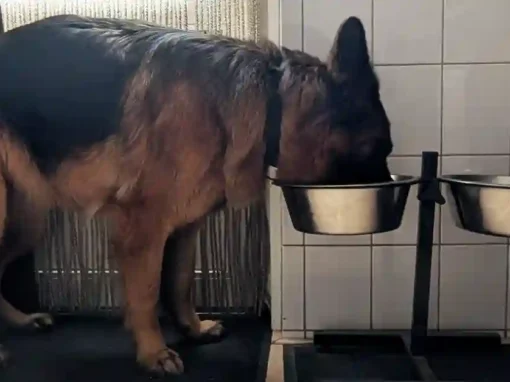
Sometimes the bowl is only half empty. Sometimes she eats less than usual.
A healthy adult dog may occasionally skip a meal. That can be unremarkable when their weight, energy, and overall health remain normal.
But pay attention to changes.
A sudden loss of appetite should not automatically be dismissed as pickiness.
Contact your veterinarian if your dog has eaten nothing for around twenty-four hours. Seek advice sooner if they are vomiting, have diarrhea, seem weak, appear painful, or otherwise seem unwell.
For puppies and dogs with medical conditions, contact your veterinarian earlier rather than waiting that long.
Leaving a little food occasionally and suddenly refusing everything are different situations.
Kibble, BARF, or Fresh Food — What Fits Your Dog?
The answer depends on your dog’s nutritional needs, health, and your household.
It also depends on whether you can store, prepare, and feed the chosen diet safely and consistently.
Kibble
Kibble is convenient, easy to portion, and usually straightforward to store.
A complete, balanced formula appropriate for your dog can meet their nutritional needs.
But the word “kibble” does not tell you how well a product has been formulated or tested. Look at the manufacturer’s expertise and quality controls, as well as the nutritional adequacy statement.
BARF and Other Raw Diets
BARF usually refers to “Biologically Appropriate Raw Food” or “Bones and Raw Food.”
Some owners report a shinier coat or smaller stools after changing to raw food. Those experiences do not establish that raw diets are healthier.
There is no convincing evidence that raw feeding provides superior overall health benefits over a balanced cooked or commercial diet.
There are documented risks, including harmful bacteria, nutritional imbalances, and injuries from bones.
Those risks affect people in the household as well as dogs. Raw feeding is especially concerning around young children, older adults, pregnant people, and anyone with a weakened immune system.
If you are considering a homemade diet, ask your veterinarian for a referral to a suitably qualified veterinary nutritionist.
Professional formulation can address nutritional balance. It does not remove the infection risks of uncooked ingredients.
Fresh Food
Commercial fresh food may be cooked or raw.
That distinction matters. “Fresh” is a description, not a guarantee of safety or nutritional quality.
Check whether the product is complete and balanced for your dog’s life stage.
A complementary food, topper, or product labeled for intermittent or supplemental feeding should not be used as the entire diet unless a veterinary nutrition professional has designed an appropriate feeding plan.
Follow storage, handling, and use-by instructions carefully.
What We Choose
After nearly thirty years, good-quality kibble remains a practical choice for our household.
Zara’s condition helps guide us: a healthy weight, good energy, comfortable skin, and well-formed stools.
Stool is useful information, but it is not a diagnosis.
Loose, unusually bulky, or strong-smelling stool can have many causes, including overfeeding, a rapid food change, stress, parasites, or illness.
Persistent changes deserve attention.
How Much Should You Feed a German Shepherd?
The feeding guide on the package is a starting point.
Dogs differ in activity, metabolism, age, and health. Foods also differ in calories.
Start with the recommended amount, accounting for treats and extras. Then monitor weight and body condition and adjust as needed.
For a dog in a healthy body condition:
- The ribs should be easy to feel beneath a light covering of fat.
- A waist should be visible when viewed from above.
- The abdomen should tuck upward behind the ribs when viewed from the side.
A thick coat can hide the outline, so use your hands as well as your eyes.
On the commonly used nine-point body condition scale, around four or five is generally ideal.
If the ribs look unusually prominent or your dog is losing weight, do not automatically assume that more food is the whole answer. Their diet and health may need assessment.
If the ribs are difficult to feel, the daily calories may need reducing. Your veterinarian can help you set an appropriate target.
A young, active Shepherd may need more calories than an older, quieter dog.
Feed the dog in front of you, and check their progress.
Emergency: Recognize Possible Bloat and GDV
German Shepherds are large, deep-chested dogs, a body type associated with an increased risk of gastric dilatation-volvulus, or GDV.
The stomach expands and may twist. This is a life-threatening emergency.
Warning signs include:
- Repeated attempts to vomit without bringing anything up
- A swollen or enlarging abdomen
- Restlessness or obvious distress
- Excessive drooling
- Weakness or collapse
You do not need to see every sign before seeking help.
Call an emergency veterinarian immediately and arrange urgent treatment. Do not wait to see whether it passes.
Splitting the daily food into multiple meals avoids feeding one very large meal, but it does not guarantee protection against GDV.
Ask your veterinarian about your dog’s individual risk.
German Shepherd Nutrition — A Quick Recap
- Look beyond the first ingredient. Check nutritional completeness, suitability, and the manufacturer’s expertise and quality controls.
- For routine food changes, transition gradually and adjust the pace to your dog.
- Feed growing puppies a complete diet suitable for large-breed growth. Check adult-food timing with your veterinarian.
- Do not add calcium or mineral supplements without veterinary advice.
- If you offer egg, serve it thoroughly cooked and plain. Investigate recurring skin or coat problems.
- Raw diets carry infection, nutritional, and bone-related risks. A professionally balanced recipe does not eliminate every risk.
- Check whether fresh food is cooked or raw, and whether it is complete or supplemental.
- An occasional unfinished meal may be normal. A sudden appetite change or other symptoms needs attention.
- Adjust portions using weight and body condition, rather than the package alone.
- Know the signs of GDV and seek emergency care immediately.
What do you feed your German Shepherd — kibble, fresh food, or something else? Tell us in the comments.
Follow us on YouTube, TikTok, and Instagram for more from everyday life with our dogs.
Experience, With the Facts Kept in View
We write from nearly thirty years of living with German Shepherds, including the lessons we learned while feeding them. We identify personal experiences as personal experiences. We check nutrition and health information against reliable sources. And when something is uncertain, we say so.